PRINTERS, PATENTS & PATON & 1881 census

Beatrice & Glennys Hollande Paton ancestors
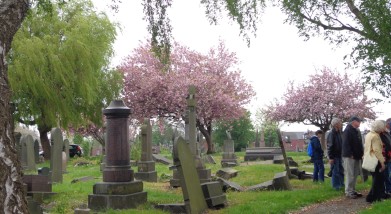
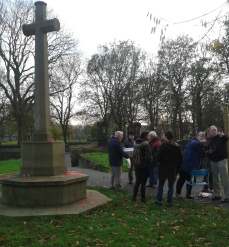
On a blustery rainy Saturday on 18th May a family from Derbyshire and Huddersfield came to Holbeck Cemetery to visit their ancestor’s grave. Beatrice is Adam Paton’s great, great, granddaughter and Glennys  is his great, great, great granddaughter.Thankfully the pouring rain stopped at the right moment as you see by the photo.
It is always exciting for a family to discover things about their ancestor, and great for the Friends of Holbeck Cemetery when they have helped to gather and research the information for them.

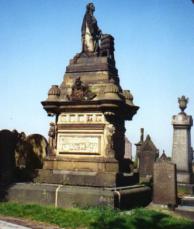
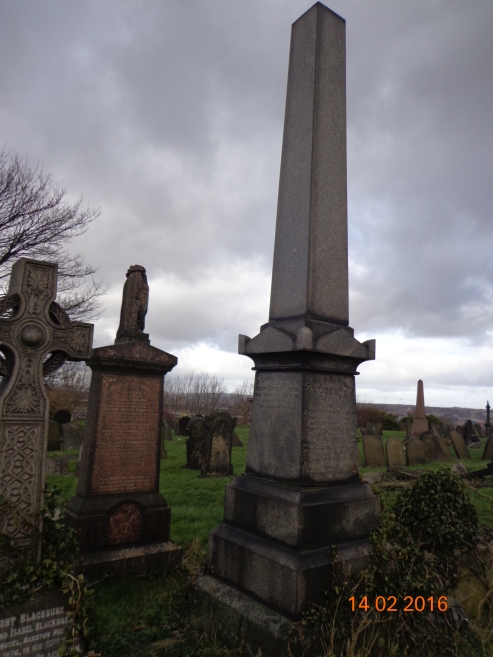
Interesting for FOHC is that Adam Paton has one of the first memorials that really intrigued us. It stands quite near to the most magnificent Marsden memorial but Adam’s is only about 12 inches high with the simple inscription: -Adam Paton, Inventor Edinburgh & Leeds born 31st March 1836, died January 7th 1892

After I spent ages studying the 1881 census to try and find out about him. I came up with a blank and it took a friend of mine, with no connection to Holbeck Cemetery, to find Adam while researching her own family tree. What made it more difficult was that Adam Paton had been visiting London in that year to further his business. He was staying at Walter C. Keeble’s Coffee House with his 14 year old son, Henry. The census tells us that Adam was 45years old and a Master Printing Machine Maker (E & M) & his son was an Apprentice Machine Maker.

All this info led me to visit the Patent Office in Leeds where they were delighted to provide me with detailed copies of his patents. These illustrate Adam’s involvement in the early development of improvements to Letter-press Colour-Lithographic Printing machines from 1867. His patents were applied for in 1867, 1883 & twice in 1889 & relate to changing the brake on a cylinder on the printing press, adjusting the inking apparatus, making the cylinder smaller and finally the application of ink-distributing cylinders instead of inking-tables or slabs. All very technical, but 70 year old retired printers have spoken to me about how they remember using Adam’s machines when they were working and they are amazed to discover how these innovations took place in the 1880s.

 Several years ago  I was contacted by relatives of Adam from Canada, via the internet, and documents were exchanged and I was given family trees, copies of births, marriages & death certificates and photos to add to what we already knew of him.
He had brought the small Arab Platen machine from Edinburgh where he was registered in 1863 as an engineer, millwright & cylinder–printing machine maker of 8 North College Street moving to 1 Broughton Place in 1864/5. We also know that while he was in Edinburgh his son, .Henry lost an eye while playing on his rocking horse! Adam then seems to have decided to bring his invention to Leeds, and  he travels there with his wife, Esther, and family.

He is listed in  White’s Leeds Trade Directory of 1870 as living at 27 Cemetery Road and his company is listed as Adam Paton (Bros) Paragon Works, Elland Road, employing 32 men & 3 boys.

We know that Adam’s wife went to live in Scarborough after he died and she was a serious Spiritualist as was Henry’s wife, Eliza. Spiritualism was very popular in Victorian times and many famous people were also interested in it.  Arthur Conan Doyle writer of the Sherlock Holmes stories was one such follower as was Rudyard Kipling, writer of Jungle Book.
Colleen Harnett from the Canadian connection has supplied us with all sorts of interesting stories about Adam which are too numerous to mention here and it was while she who doing more research that she discovered Beatrice & Glennys, the relatives that we met on Saturday. Beatrice and Glennys are so thrilled at having all these connections that they are going over to Vancouver later this year to meet up with the Paton family, taking photos from their visit to Holbeck Cemetery along with them.

Posted in Uncategorized | Tagged , , ,

Leeds United ,Noster Terrace & Holbeck Cemetery

LUFCOne of the houses in Noster Terrace holds a secret connection to Leeds United. This is no fantastic Victorian mansion with a blue plaque, it is just an ordinary through terrace house facing Holbeck Cemetery and overlooking Beggars Hill, which in turn, looks down on Leeds United’s football ground.
It is a Victorian terrace built as part of a development of back-to-backs streets by Joseph Pullan on 6 acres of land in Beeston. He purchased the land in 1893 at the cost of £1300 and built all the streets with the names Noster & Marley.
On 24th August 1923 this house was bought by Leeds United Association Football Club Limited.
At a meeting of the Directors held at the Griffin Hotel on the 26th June 1923 it was proposed by Mr Ray Aspinall & seconded by Mr Mark Barker, that it was resolved that the sum of £480 be borrowed on the mortgage for the house in Noster Terrace in the City of Leeds from Leeds Permanent Benefit Building Society. The solicitors were Messrs Middleton .
Directors of LUAFC who signed it were:- J Hilton Crowther, Kaye Aspinall, Alf Masser, Harold Tetley and Sir Berkeley Moyihan.
The mortgage agreement for £480 between Leeds Permanent Benefit Building Society & Leeds United was approved on 24th August 1923. (It was finally paid off on 5th November 1942)
Leeds United kept the property until 22nd January 1958 when it was sold to a family.
The house was used as a base for some of the Leeds United team managers. Norman Williams lived here in 1925 and in 1932 Dick Ray was living here.Quite handy for the ground!!
Later Holbeck Cemetery was the setting for Tony Harrison’s poem ‘V’ which featured LU football fans .

Posted in Uncategorized | Tagged , , ,

Evan Thomas Jones -World Champion Swimmer

Did you know that a Victorian World Champion swimmer is buried in Holbeck cemetery ?

Evan Thomas Jones, who was born in Holbeck, died on 3rd March 1904 aged 54 years.

Picture1

The Yorkshire Evening Post published the following article about him on March 4th 1904 

DEATH OF E.T.JONES

By the death of E.T. Jones which occurred in Leeds yesterday one of the old schools of professional swimmers disappears, the successful rival of J B Johnson, W Beckwith , James Finney and Arthur Robinson. At one time   Jones was recognised champion swimmer of the world . On August 3rd 1874 he won the mile championship in the Serpentine , London and in 1876 he was the victor in the 1000 yards race in Waterloo Lake at Roundhay Park, covering the distance in 15 minutes 56 and 1/2 seconds . Twice in 1876  and three times in 1877  Jones repeated his victories over the Thames championship course and on the last occasion swam the mile in 25 minutes and 22 and3/4 seconds. In 1881 he beat W, Beckwith in the 500yards championship at Roundhay, and some years later defeated James Finney in the same championship. More recently Jones was for a time swimming instructor for the Leeds School Board and was very popular with the boys.  

The Yorkshire Post 4th March 1904 also has a report.

DEATH OF E. T. JONES

We regret to have to record the death of E T Jones of Leeds, ex-champion swimmer of the world, yesterday which took place at his residence in Leeds at about five o’clock yesterday afternoon. He had been lying  ill for many months , suffering from consumption. Jones was in his fifty-fourth year , having been born at 4 St. John ‘s Place, Holbeck  on May 7th 1850. He stood almost 5 foot 5inches in height and his swimming weight , when in his best form was 10 stone.

    In his day Jones met and defeated all the best men at varying distances , and was without doubt,the best man the world had ever seen up to his own time.He won the mile championship in the Serpentine on August 3rd 1874, and, on September 12th of the same year he won again over the Thames Championship course. In 1875 Jones was again successful in the Edgbaston Reservoir, Birmingham and in 1876 he won the 1000 yards race  in the Waterloo  Lake, Leeds swimming the distance with two turns in the remarkable time of 15 minutes  56 and 3/4 seconds. Twice in 1876 and three times in 1877 Jones repeated his victories over the Thames Championship course , and on the last occasion he swam the mile in 25 minutes 2 and  3/4 seconds . On September 3rd 1881 Jones defeated W Beckwith of London in the 500 yard championship in Waterloo Lake . In the same lake some years later , Jones defeated James Finney for the quarter-mile championship, and this, we believe was his last championship performance .Jones’ last money match was against J Maddock , Leeds in Union Street Baths, Leeds in December 1897. The distance was 100 yards and Jones won cleverly. 

It is hard to believe today but the simple act of swimming was once a major professional sport.This sport was  cold-water swimming or white-water swimming  , as it was known in the USA.

In the late 1870′s and 1880′s professional exhibition swimming and endurance races were popular sporting events with high purses, heavy wagering and stiff competition more on a par with professional wrestling and boxing or Las vegas stunts than amateur sports.

Swimming was the new phenomenon in the 1800′s , gaining so much popularity that a Swimming Society was started in England in 1828, which led to heated swimming  in public swimming-baths where the professionals produced feats of speed-racing and endurance for spectators.

The term ‘professional swimmer’ or ‘professor of swimming’, referred to many activities, and provided a full time occupation  for most of the swimmers .

Most of the champion or professional swimmers were interested in competing in swimming events to earn money.As the ability of swimmers increased , the need to train regularly  became essential and the policy of most baths was that they  only permitted the bath superintendant to teach swimming. This meant that professionals such as ET Jones had to find this employment if they wished to compete and teach successfully.

The weekly wages for a Baths Supervisor in Liverpool in 1856 was 40 shillings (£2) but for a baths attendant the wages were only 24 shillings (£1.20)But usually these men were laid off during winter months when the baths closed .

So it is no wonder that swimmers wanted to earn extra through competing and promoting popular ‘aquatic shows’ , which attracted as many as 4000 people in 1840 at the Mount Street Baths, London .

 One very famous swimmer was Captain Webb who used to feature on boxes of matches.He went on to write a book entitled ‘The Art of Swimming’. Lambeth Baths in London was the site of the 1879 ‘Trials of Endurance’ where literally the winner was the one who covered the most distance in 6 days ( 145 hours of swimming!)Webb was the only swimmer who persisted in the breast-stroke rather than the newer ‘sidestroke’ and he won the Champion of England title  easily by swimming 3522 lengths  or 74 miles. Winners were offered prize money of £70 which was a considerable sum in those days and well worth all the effort.

 These swimmers often competed in the USA and J B Johnson of the Serpentine Swimming Club, London beat Truatz at Long Beach, USA in the 1870′s

cemscul1

NOTE: The next gravestone  to ET Jones is also in memory of  a Jones family but this was a mustard maker – another interesting fact about Holbeck Industries !! 

Posted in Uncategorized

Holbeck Cemetery hits the airwaves again

Eve & Blake Morrison

Eve & Blake Morrison

Why did BBC Radio 4 come to visit the cemetery on Tuesday 29th January at 9a.m?

It is all because Holbeck Cemetery contains Tony Harrison’s parent’s and grandparent’s grave plot.

In case you don’t know, Tony Harrison is a world class poet who became notorious in 1987 for his poem ’V’. The film of the poem was due to be broadcast on Channel 4 but it sparked outrage because of its language and was even debated in Parliament, before eventually, being aired later in the evening.

The poem ‘V’ had been written in 1985 and it tells of his visit to the family grave-plot only to see it covered in graffiti of the worst kind.

Tony Harrison was born in Leeds in 1937 and gained a scholarship to Leeds Grammar School and later attended Leeds University.

Being a working class scholarship boy he is interested in class and one of his earlier collection of poems is ‘The Loiners’(1970)( Loiners are residents of Leeds) where he writes of  his anguish of class , family and the struggle to acquire culture.

In 1985 when he visited Holbeck Cemetery it took him some time to locate his family’s plot only to see it daubed with offensive words of graffiti. His poem captures that moment in history where the mining 2013-01-30 13.49.37industry and other traditional industries were in decline. Football hooliganism was at its height and lager-swilling yobbos seemed to be taking control.

Portrait of Tony Harrison by Christopher Stevens 1993 (postcard)

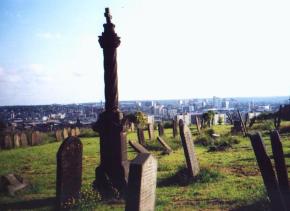
Holbeck Cemetery is built above the Beeston seam of coal and Elland Road, the home of Leeds United can be clearly seen from its grounds and all these elements are contained in ‘V’

So  Blake Morrison, poet & writer, and Lucy, researcher and sound recorder, came to interview  Eve to discuss the  changes that have occurred in the cemetery and the area about it since Tony wrote his poem. Some of this discussion will be aired on BBC Radio 4 at 11pm on February 18th just before Tony Harrison reads a new version of ‘V’.

One of the main differences to the cemetery is that the Harrison plot is now easy to find. The Friends of Holbeck Cemetery have had erected two colourful signs at either entrance which  guides the public to various points of interest throughout the cemetery. The other difference is there is little graffiti, thanks to the ‘Anti- graffiti team’ at Leeds City Council.

More people come into the grounds to walk about, gaze at the view towards the city, visit family graves, look for family history, take beautiful photographs or just walk their dogs. So it very different since that day in 1985 when it was visited by a poet who was so upset at seeing what had happened to his family’s grave.

Image  Snow January 2013

Posted in Uncategorized

Joseph Henry 1845 – 1923 .Uncrowned ‘King of Holbeck’

On the 8th November 2012 my wife and I escorted a relative of the Joseph Henry around Holbeck Cemetery and showed her the family graves and also the house where the  Henry family had lived.

Joseph Henry was born in Leeds in December 1845 to poor parents who had emigrated from Ireland in a search for work. Joseph started work at 9 years of age as a half-timer in Marshall’s Flax Mill, but he later moved on to the Round Foundry, Water Lane where he served his time learning the trade of ironfounder. On the 25th December 1868 he married a Holbeck girl Caroline Moore at Christ Church in Meadow Lane. By his efforts he was able at the age of 31  to begin his own business at the Quebec Foundry in Meadow Road and a year or two later he founded the firm of Joseph Henry Ltd in Manor Road.

Joseph was at one time a member of Leeds Trade Council and he also served for two years as the President of the Ironfounders Friendly Society. He actively associated himself with politics in the Holbeck Ward and in 1881 he was elected a member of the Holbeck Board of Guardians and soon became Chairman of that body. In 1887 he was returned as the Liberal representative for Holbeck on the City Council. His ability and courage in local politics made him the most prominent figure in the Liberal Party and by common consent he became its Leader and in this capacity he continued to devote his best energies to public work. He was a life-long total abstainer.

Joseph Henry retired as a Liberal councillor in October 1906 after 25 years of civic service; his retirement was extensively reported in all the Leeds newspapers together with the details of his retirement dinner and presentation of a large amount of silver. The silver, comprising of a coffee and tea service together with a dessert service were displayed in a local jewellers, Messrs Pearce & Son, Albion Street prior to the presentation.

In the days when he represented Holbeck Joseph Henry enjoyed such popularity and complete trust among the local people that he became known as the ‘King of Holbeck’, though uncrowned. However, his days of civic duty were not over and he was prevailed upon to return to the council in 1916, and in 1918 when aged 73 he was unanimously nominated by the Liberal Party to be Lord Mayor for 1918/19. Because Caroline, his wife, was an invalid, his daughter Ann Hartley was his Lady Mayoress. At the end of the war in 1918 there was a Holbeck Bonfire and Carnival (see advert for this on the Leeds Tapestry), the bonfire was officially lit by the Lord Mayor Joseph Henry, this event was also used to raise funds for the local Nurses Home and it raised £90 in the first year.

Joseph also became involved in the dispute between the Football League and Leeds City  Football Club even offering to run the club, but to no avail, this meant that League football came to a halt in Leeds after just eight games in the 1919/20 season, Leeds City’s place being taken by Port Vale.

Joseph Henry, whose wife Caroline had died on the 22nd September 1921, finally retired in 1922, he died on the 10th December 1923 while living in Fairfax Road where their house still stands.

by Ken Burton ; Friends of Holbeck Cemetery

photo of the  3 Henry family graves in Holbeck Cemetery

Posted in Uncategorized | Tagged , , ,

‘Focus on Holbeck’ goes Kindle

It has been a very exciting week here at FOHC as the international publisher Amazon  has asked if they can  publish Eve Tidswell’s book ‘Focus on Holbeck in 1881′ in Kindle format

The original book was written in 2005 with a foreword by Hilary Benn and illustrates the great changes that have taken place in the Holbeck area since the cemetery opened in 1857 and is based on information taken from the 1881 census. By examining the information surrounding the burials we can not only trace the family history of a given name but also acquire a wealth of information about the social history of the period:types of employment,ages of employees, public health, popular names etc.

A member of FOHC loaned us the money for the books  to be printed and we initially had 100 books published, which paid off the loan and provided funds for our Friends Group. Due to popular demand FOHC paid for another 100 to be published and they are still on sale from FOHC & Leeds Civic Trust Bookshop priced at £9.95. They are also available from  some Leeds Libraries.

People nowadays want to read books in various ways on their laptops, ipads,iphones, android phones and Kindle Readers so it will be  a great opportunity for FOHC to reach  new generations of readers  in these different  formats.

Here at Friends of Holbeck Cemetery we are not technically  minded but thankfully Steve at Write Good Books has done all the technical/digital stuff and will be helping us with the Amazon admin.

Kindle books are cheaper than paper books so the Kindle version of ‘Focus on Holbeck’ will cost £7.21 ( 30% of which goes to Amazon )FOHC profit by £4.90 per Kindle.

So now Holbeck Cemetery can be known globally  with lots of free advertisement from Amazon (and in a week or two Google will pick this up too) and direct people to us .

So if you want to check us out on AMAZON go to their Kindle page type in ‘holbeck’ and the book is the head of the list. You can even have a quick look at the first few pages.Happy reading.

Posted in Uncategorized | Tagged , ,

Help Holbeck Cemetery Plant their 105 Jubilee trees

Do you want to be part of Holbeck’s history? Do you want  to help make Holbeck Cemetery a more beautiful place for future generations in Beeston & Holbeck?

If your answer is ’yes’ to either of these questions then come and join us -The Friends of Holbeck Cemetery , Holbeck in Bloom & Beeston in Bloom together with some help from officers from LCC who will be busy planting in the cemetery on Tuesday 27th November at 10 a.m. No special skills needed just happy folk who don’t mind getting ‘stuck in’. It should be fun , so lets hope the weather is kind and we will all have a good time.

NOTE:We will be taking photos of the event to send to the Woodland Trust who awarded the trees and they will be added to their ‘Jubilee Woods’ website

To find out more about how The Friends of Holbeck Cemetery group was awarded these trees see their previous blog ‘We have won 105 trees’. This tells you how everyone involved will have their names recorded in the Royal Book which will be given to the Queen .

Posted in Uncategorized | Tagged , , ,